How Server-Side Validation Techniques Prevent Duplicate Submissions in Daily Reward Events
Cameron Koch · Jun 3, 2026

How Server-Side Validation Techniques Prevent Duplicate Submissions in Daily Reward Events
Daily reward events have become a staple feature across mobile applications, online platforms, and loyalty programs where participants claim incentives at regular intervals, and server-side validation serves as the primary mechanism to block repeated claims from the same user within the designated time window. These systems operate by checking requests against centralized databases before any reward gets issued, which reduces opportunities for users to exploit client-side loopholes or manipulate local device data.
Core Mechanisms Behind Duplicate Prevention
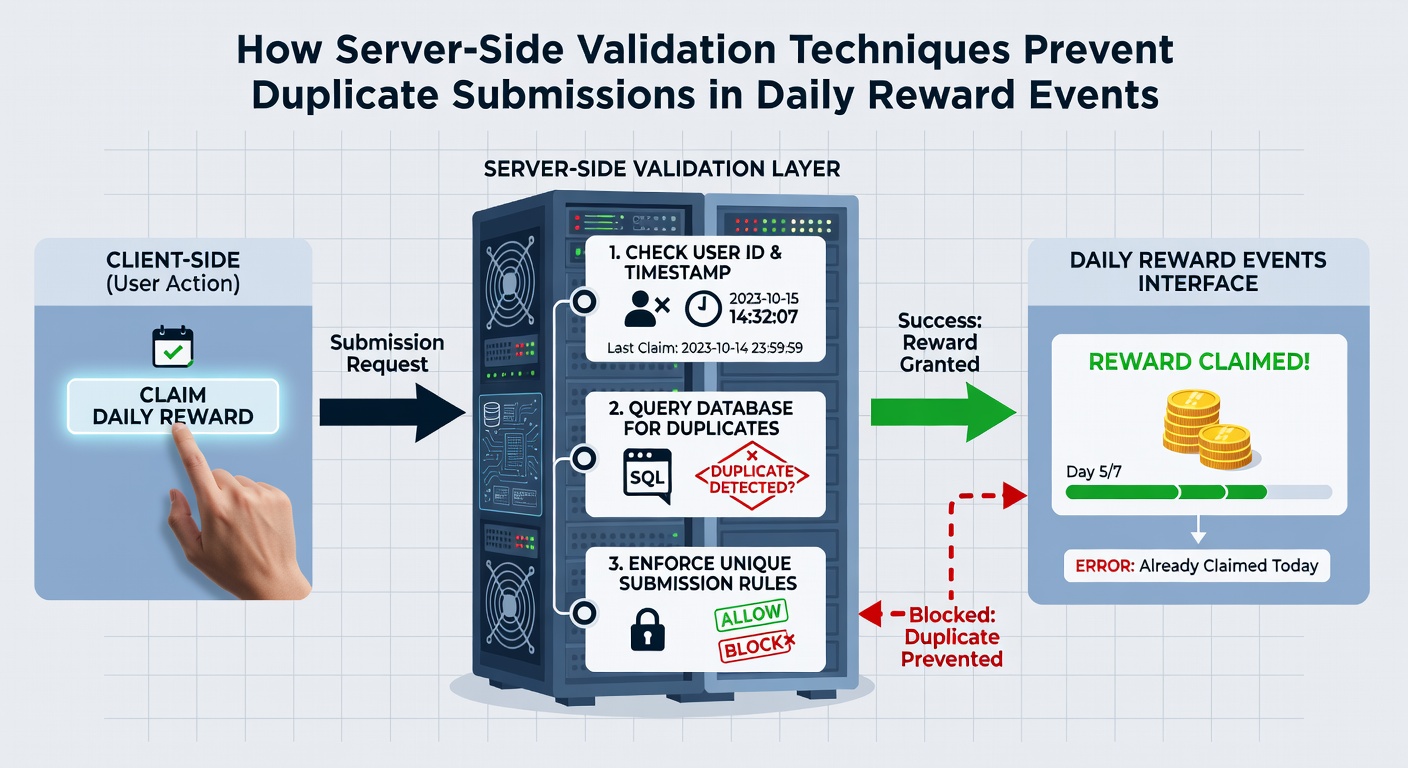
Server-side checks begin the moment a submission request arrives at the application server, where algorithms compare incoming data points such as user identifiers, timestamps, and device fingerprints against stored records from previous interactions. This process runs independently of any information sent from the user's device, which means attempts to alter local storage or bypass front-end restrictions fail automatically when the server detects an existing claim for that reward cycle. Data from multiple platforms shows that implementing these checks cuts duplicate submissions by more than half in the first month after deployment.
Timestamps play a central role because each reward event carries a defined eligibility period, often aligned to calendar days or specific hourly windows, and the server verifies whether the current request falls within an already claimed slot by cross-referencing against logged entries. When a match appears the system rejects the submission and may log the attempt for further review without notifying the user of the exact detection method.
Database and Session Management Strategies
Centralized databases store every successful claim with associated metadata including account ID, IP address ranges, and session tokens, which allows real-time queries to confirm uniqueness before processing continues. Researchers at various technology institutions have documented how relational database constraints, such as unique indexes on user-reward-date combinations, enforce these rules at the storage level and prevent race conditions where simultaneous requests might otherwise slip through.
Session management adds another layer because servers maintain active user sessions tied to authentication tokens that expire or rotate regularly, and any new submission attempt must present a valid token that the backend validates against current session records. This approach proves especially effective in environments where users switch between multiple devices since the server tracks activity across all associated endpoints rather than relying on a single device identifier.
Advanced Techniques and Geographic Considerations
Rate limiting combined with validation rules further strengthens protection by capping the number of requests an account or IP range can make within short timeframes, and these limits get enforced entirely on the server side where they remain invisible to end users. In June 2026 several major reward platforms updated their systems to incorporate machine learning models that flag anomalous patterns, such as rapid successive attempts from similar network locations, even when basic identifiers appear unique.
Geographic regulations influence implementation details because data residency requirements in regions like the European Union and Australia mandate that validation records stay within specific jurisdictions, which affects how servers synchronize information across distributed data centers while still maintaining consistent duplicate checks. Observers note that companies operating globally often maintain separate validation clusters per regulatory zone to comply with these rules without compromising detection accuracy.
According to findings published by the National Institute of Standards and Technology, robust server-side controls reduce fraud incidents in digital incentive programs by establishing verifiable audit trails that support compliance reporting. A separate analysis from the Australian Competition and Consumer Commission highlights how transparent validation processes build participant trust when platforms clearly communicate that claims undergo backend verification.
Conclusion
Server-side validation techniques continue to evolve alongside daily reward events by combining database constraints, session controls, timestamp verification, and emerging pattern detection to maintain fairness across participant bases. These methods operate behind the scenes yet form the foundation that keeps reward systems functional and equitable as participation volumes grow. Platforms that invest in these backend safeguards consistently report lower rates of abuse and smoother operational performance over extended periods.