How Privacy Legislation Prompts Adaptations in Global Reward Distribution Protocols
Greta Coleman · Aug 5, 2026
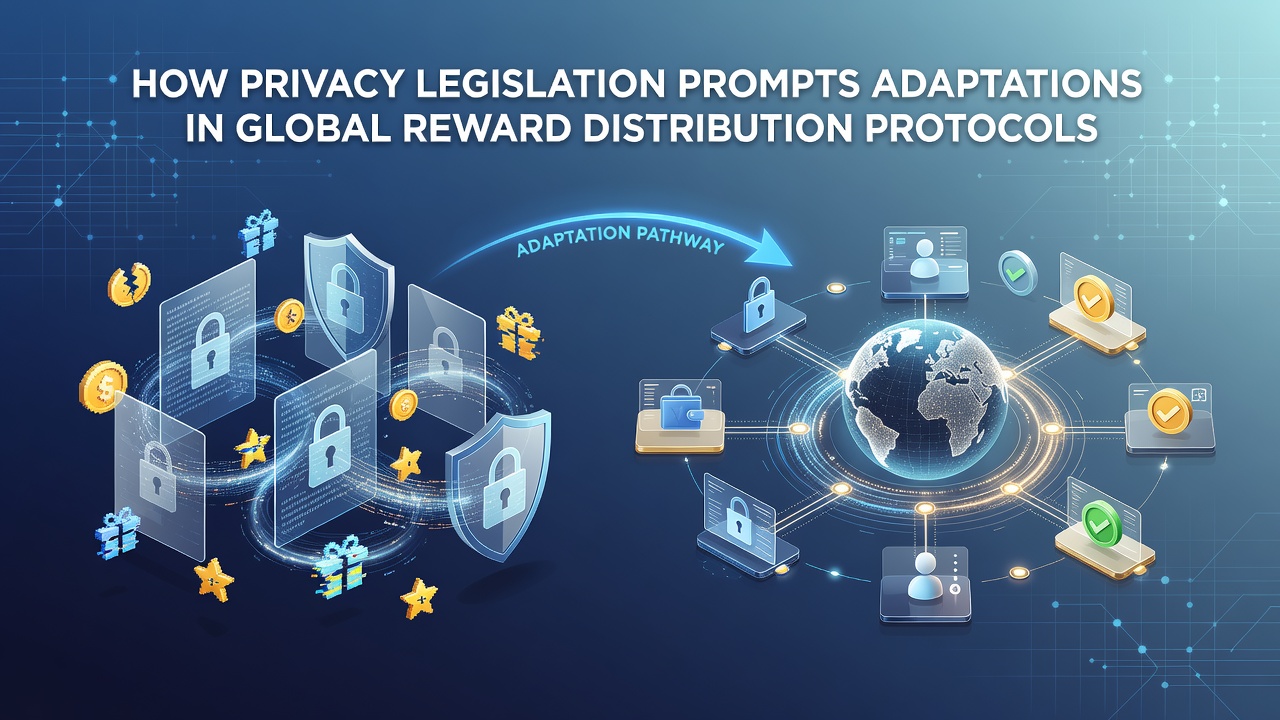
How Privacy Legislation Prompts Adaptations in Global Reward Distribution Protocols
Privacy legislation continues to reshape how organizations structure reward distribution systems worldwide, forcing updates to data handling practices that once relied on broad collection and cross-border transfers of participant information. Laws such as the European Union's General Data Protection Regulation and Canada's Personal Information Protection and Electronic Documents Act establish strict requirements for consent, data minimization, and secure processing that directly affect protocols used in international prize and incentive programs.
Organizations managing global reward events now integrate layered consent mechanisms at the point of entry, while encryption standards and pseudonymization techniques replace older methods that stored full personal identifiers in centralized databases. These shifts emerged after enforcement actions demonstrated that non-compliance could halt distributions in multiple jurisdictions simultaneously.
Core Legislative Drivers and Regional Variations
The General Data Protection Regulation requires explicit consent and limits data retention periods, prompting reward platforms to redesign entry forms so participants select only necessary fields rather than defaulting to comprehensive profiles. Similar rules appear in Brazil's Lei Geral de Proteção de Dados and Japan's Act on the Protection of Personal Information, each carrying distinct notification timelines and penalty structures that companies must track separately. Observers note that programs operating across these regions often maintain separate data pipelines to isolate processing activities and avoid unintended transfers that violate localization mandates.
According to the European Commission, updates to cross-border transfer mechanisms in 2023 required additional safeguards such as standard contractual clauses for any reward data moving outside the European Economic Area. Programs that distribute prizes to European residents therefore route verification steps through regional servers before aggregating anonymized statistics for global reporting.
Technical and Procedural Adjustments in Distribution Systems
Engineers have implemented token-based authentication systems that replace direct storage of email addresses and names during eligibility checks, allowing verification without retaining identifiable records beyond the minimum period required for tax reporting. Automated deletion scripts now trigger after prize fulfillment, and audit logs capture only hashed identifiers to support dispute resolution while satisfying retention limits. One study revealed that such modifications reduced data breach exposure surfaces by segmenting participant records from financial payout ledgers.

Multi-jurisdictional programs also adopted differential privacy techniques when generating winner announcements and aggregate reports, adding calibrated noise to datasets so individual entries cannot be reverse-engineered. These methods satisfy transparency obligations under several statutes while protecting the underlying participant pool from re-identification risks.
Cross-Border Coordination and Compliance Timelines
Teams coordinating reward events across Asia-Pacific and North American markets maintain jurisdiction-specific data maps that flag which fields require additional safeguards, such as explicit opt-in for marketing use or separate storage for tax identifiers. In August 2026, scheduled reviews of adequacy decisions between several trading partners are expected to prompt further protocol revisions for any reward distributions involving updated transfer impact assessments.
Research from academic institutions indicates that companies adopting unified compliance dashboards reduced the time needed to adjust protocols when new guidance emerged, because the systems already tracked consent versions and deletion schedules per region. Those dashboards integrate with payout processors to confirm that bank details or digital wallet addresses are processed only after eligibility confirmation and then purged according to predefined schedules.
Verification Methods and Fraud Prevention Updates
Traditional duplicate detection that matched full names and addresses gave way to privacy-preserving record linkage using cryptographic hashes, enabling programs to identify repeat entrants without exposing raw data across borders. Blockchain-based ledgers record only commitment values rather than personal details, supporting audit trails demanded by regulators while aligning with data minimization principles embedded in multiple statutes.
Industry reports show that these adaptations maintain program integrity even as participant volumes grow, because validation occurs through zero-knowledge proofs that confirm eligibility attributes without revealing underlying information. Organizations continue to refine these approaches as enforcement bodies release updated guidance on emerging technologies.
Conclusion
Privacy legislation has driven measurable changes in reward distribution protocols, including segmented data flows, shortened retention cycles, and advanced cryptographic verification methods that operate across diverse regulatory environments. Continued alignment with evolving statutes will determine how efficiently global programs can scale while meeting consent, security, and transfer obligations in each participating jurisdiction.