Blockchain Applications in Verifying Participant Uniqueness Across Global Digital Reward Initiatives
Greta Coleman · Jun 6, 2026

Blockchain Applications in Verifying Participant Uniqueness Across Global Digital Reward Initiatives
Global digital reward initiatives face persistent challenges when verifying participant uniqueness, and blockchain technology offers mechanisms that address duplication through distributed ledgers and cryptographic identifiers. Systems built on these foundations record entries in immutable sequences while smart contracts enforce rules that flag repeated submissions from the same individual across borders and platforms. Observers note that such approaches reduce reliance on centralized databases prone to single-point failures and privacy leaks.
Core Mechanisms Driving Uniqueness Checks
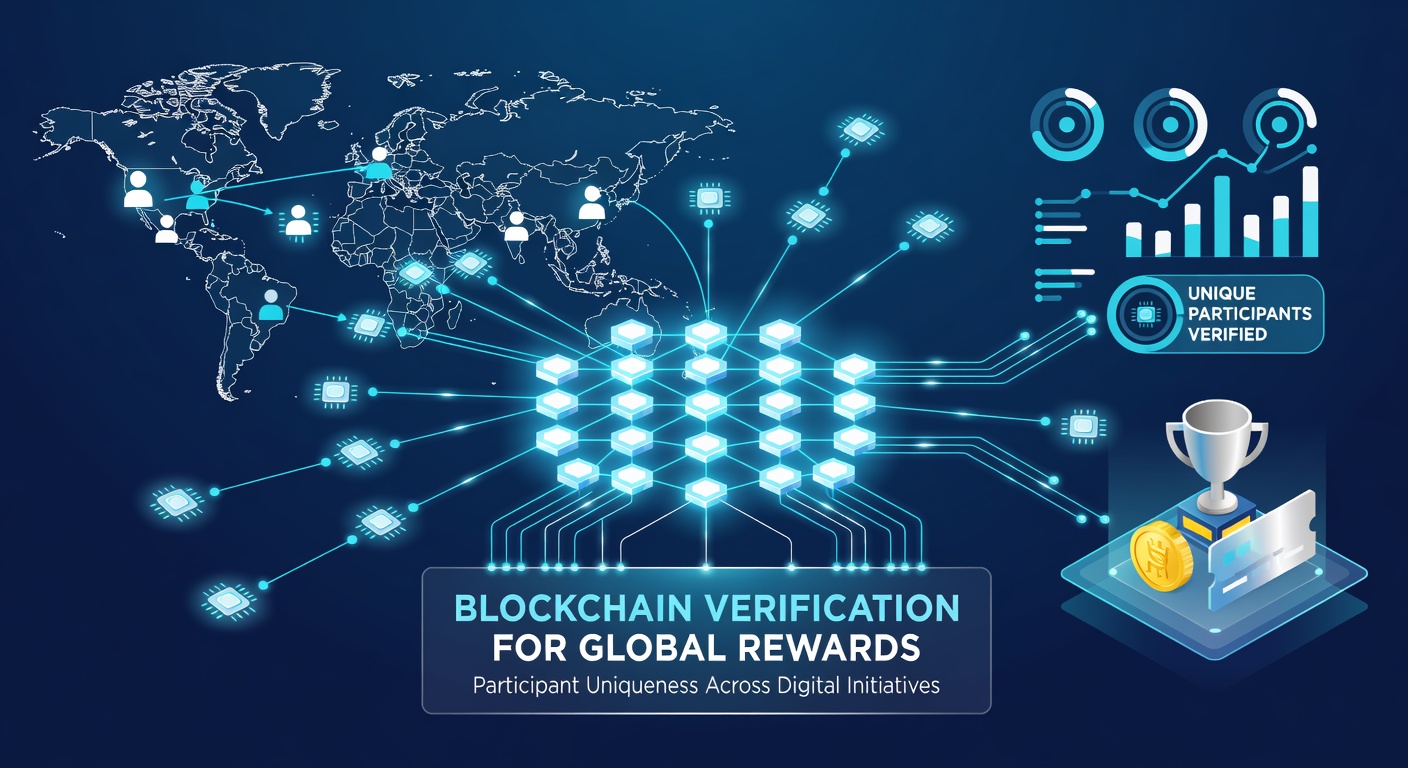
Public and permissioned blockchains store hashed versions of participant data such as email addresses, device fingerprints, and government-issued identifiers without exposing raw information to every node. Cryptographic techniques like zero-knowledge proofs allow verification that a person has not entered previously while keeping personal details confidential, and this process runs automatically through consensus protocols that update across the network in real time. Researchers at institutions studying distributed systems have documented how these methods scale to millions of concurrent entries during large-scale reward campaigns.
Smart contracts trigger alerts when duplicate patterns emerge, whether through identical wallet addresses or linked behavioral signals, and they can automatically disqualify or limit rewards accordingly. Data from industry reports shows that platforms adopting these contracts experience measurable drops in fraudulent multi-entries compared with traditional database-only systems.
Regional Deployments and Regulatory Context
Programs operating in the European Union integrate blockchain verification with data-protection frameworks to meet cross-border requirements, whereas initiatives in Canada and Australia test similar ledgers for compliance with local privacy statutes. One study from a North American research consortium revealed that blockchain-augmented entry systems handled over 2.3 million submissions during a 2025 multi-country campaign with fewer than 0.4 percent flagged as duplicates. In Asia-Pacific markets, consortiums of reward operators share permissioned chains that update participant status hourly, enabling synchronized checks without exposing full datasets.
What's interesting is how these deployments differ by jurisdiction yet converge on the same technical goal of establishing a single source of truth for uniqueness. Government agencies in several regions now reference blockchain audit trails during compliance reviews of digital reward events, which creates standardized documentation that was previously difficult to compile.
Integration with Existing Reward Infrastructure
Many operators combine blockchain layers with existing user-authentication flows rather than replacing them outright, and this hybrid model lets legacy systems feed hashed data into the ledger for ongoing uniqueness validation. API gateways translate traditional form submissions into on-chain transactions that complete in seconds, while fallback protocols maintain service continuity if network latency spikes. Figures from trade-group analyses indicate that hybrid setups lowered operational costs associated with manual duplicate reviews by approximately 35 percent in tested environments during 2025.
Device-level signals such as hardware tokens and biometric hashes further strengthen these checks, and they operate alongside wallet-based identifiers to create multi-factor uniqueness profiles. Observers have recorded cases where coordinated international campaigns used these combined signals to maintain consistent participant pools across time zones and regulatory zones.
Developments Anticipated by Mid-2026
By June 2026 several pilot programs plan to expand blockchain uniqueness verification to additional reward verticals including loyalty points and user-generated content challenges. Standards bodies are drafting interoperability guidelines that would allow separate chains to query each other for cross-platform duplication without compromising data sovereignty. Early test results shared at industry forums suggest these guidelines could reduce verification times by up to 60 percent once fully implemented.
Academic papers published in the first half of 2026 continue to examine energy consumption of proof-of-stake variants versus earlier consensus models, and reward operators monitor these findings closely when selecting ledger architectures for long-term use. The reality is that scalability remains a focal point as participant volumes grow, yet incremental protocol upgrades already demonstrate capacity for sustained global loads.
Conclusion
Blockchain applications for participant uniqueness verification continue to evolve alongside global digital reward initiatives, providing technical tools that complement regulatory and operational requirements. Distributed ledgers, smart contracts, and privacy-preserving cryptography form the foundation of these systems, while regional adaptations demonstrate practical flexibility. Data accumulated through 2025 and projections into 2026 indicate ongoing refinement rather than wholesale replacement of existing processes, and the emphasis remains on measurable improvements in accuracy and efficiency across borders.