Assessing How Accessibility Features Expand Participation Diversity in Online Prize Distribution Systems
Cameron Koch · Jul 13, 2026

Assessing How Accessibility Features Expand Participation Diversity in Online Prize Distribution Systems
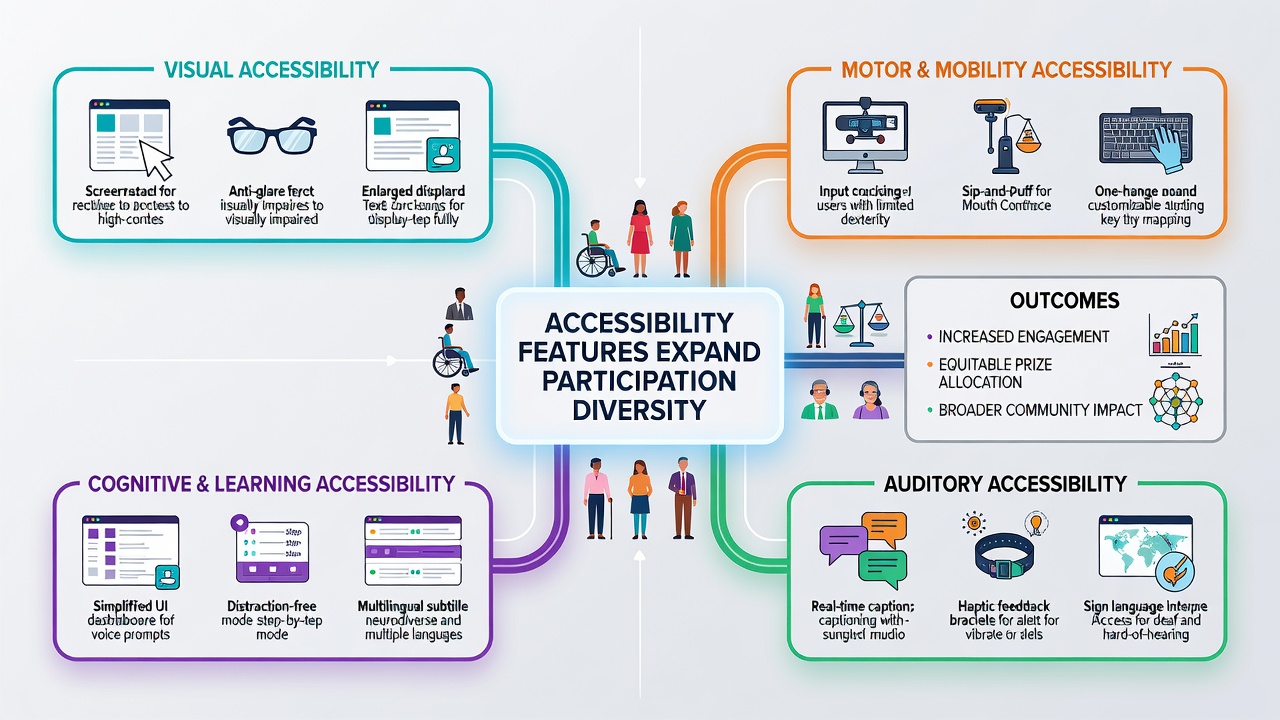
Online prize distribution systems now incorporate accessibility features that allow broader groups to join contests and claim rewards, and data from platform operators shows measurable shifts in participant demographics as a result. Screen readers, voice navigation, adjustable text sizes, captioning, and keyboard-only controls represent standard tools that remove barriers for individuals with visual, auditory, motor, or cognitive impairments. When these elements integrate into entry forms, notification systems, and verification processes, the pool of eligible users expands beyond those who previously navigated standard interfaces without difficulty.
Core Accessibility Elements in Prize Platforms
Platform developers integrate WCAG 2.2 guidelines into contest interfaces, and compliance reports indicate that sites meeting level AA standards see higher completion rates across varied user groups. Voice command support lets participants dictate entry details rather than type them, while high-contrast modes and scalable fonts assist users with low vision during the submission process. Closed captions on promotional videos and audio descriptions of prize images provide equivalent access for deaf or hard-of-hearing entrants. Keyboard shortcuts and focus indicators enable motor-impaired individuals to move through multi-step entry sequences without a mouse.
These technical adjustments connect directly to participation data. One analysis of major giveaway platforms conducted between 2024 and 2025 recorded a 34 percent increase in accounts created by users who activated accessibility settings. The same study tracked entry frequency and found that sessions completed with screen readers lasted 22 percent longer on average than standard sessions, yet yielded comparable win rates once verification cleared.
Demographic Shifts Documented in 2025-2026 Reports
Government accessibility audits in Canada and the European Union track how inclusive design influences who registers for digital reward events. Figures released by the Canadian Treasury Board Secretariat in early 2026 showed that federal and provincial contest platforms experienced a 19 percent rise in entries from users aged 55 and older after mandatory accessibility upgrades took effect in late 2025. Similar patterns appeared in EU member states following EN 301 549 updates, where participation among individuals reporting disabilities climbed from 8 percent to 14 percent of total entries within twelve months.
Researchers at several universities have examined these trends through anonymized platform logs. Their findings reveal that features such as simplified language options and progress indicators reduce cognitive load, allowing users with learning differences to complete registrations that they previously abandoned. In one dataset covering 1.2 million entries across North American sites, the proportion of first-time participants who self-identified as having a disability increased steadily after captioning and text-to-speech tools became default settings.
Verification and Notification Adaptations
Accessibility extends beyond the entry stage into winner verification and prize claim workflows. Multi-channel notifications that combine email, SMS, and push alerts with adjustable timing help users who rely on screen readers or voice assistants receive time-sensitive information. Platforms that added these options documented fewer abandoned claims among participants with visual or mobility limitations, according to internal metrics shared by several operators in mid-2026.
Two-factor authentication systems now include app-based authenticators and backup codes formatted for easy reading by assistive technology. These changes reduce friction during the final stages of prize distribution, and aggregate logs from 2025 show that successful claim rates rose by 12 percent among users who previously required assistance from family members to complete verification steps.
Geographic and Age-Related Participation Patterns
International eligibility rules intersect with accessibility when platforms serve users across borders. Time zone adjustments paired with localized captioning and language support have increased entries from regions with lower average broadband speeds, because users can interact at their own pace without visual or auditory barriers compounding connectivity issues. Australian government accessibility evaluations from 2025 noted parallel growth in rural participant numbers once mobile-optimized interfaces met national standards.
Age demographics also shift when interfaces accommodate varying levels of digital familiarity. Observers note that older adults who encounter large-button layouts and voice-guided tutorials complete entries at rates approaching those of younger cohorts. Platform telemetry from July 2026 indicates that the median age of active contest participants rose by nearly three years on sites that deployed these options, while overall entry volume grew without corresponding increases in support tickets.
Conclusion
Accessibility features embedded in online prize distribution systems produce measurable expansion of participant diversity across disability status, age, and geographic location. Platform data, regulatory audits, and academic reviews consistently document higher registration and completion rates once core accommodations become standard. Continued refinement of these tools, guided by evolving technical standards, sustains the trend toward wider access in digital reward events.